
China’s Naval Expansion: Preparing for Taiwan?
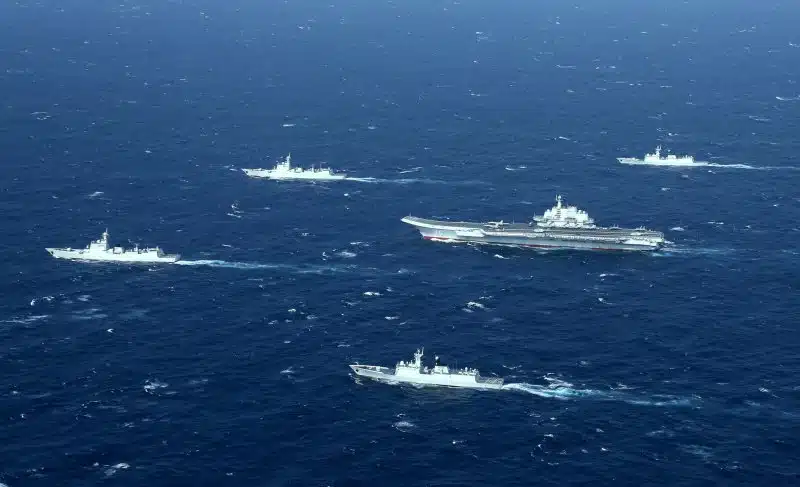
Recent reports highlight China’s strategic preparations for a potential military operation against Taiwan, focusing on its formidable naval capabilities. With the world’s largest army and an extensive shipbuilding industry, China is enhancing its logistical advantages for a possible invasion. Experts suggest that while the People’s Liberation Army (PLA) Navy boasts hundreds of warships, it may still face significant challenges in executing a successful amphibious assault on Taiwan.
China’s Naval Strength and Strategic Goals
China’s naval capabilities have surged in recent decades, transforming it into a maritime power that rivals the United States. Currently, China operates approximately 405 warships compared to the U.S. Navy’s 295, with projections indicating an increase of at least 30 additional vessels by 2030. Despite a military budget significantly smaller than that of the U.S. — $246 billion in 2025 versus $850 billion — China’s shipbuilding capacity is estimated to be at least 200 times greater than that of the U.S. This growth is underscored by a recent report from the Stockholm International Peace Research Institute (SIPRI), which noted that while many of China’s defense sectors have seen revenue declines, shipbuilding remains a booming industry.
China’s shift towards maritime defense has been driven by increasing existential threats from the sea, particularly concerning territorial disputes in the South China Sea and its claims over Taiwan. President Xi Jinping has made the “reunification” of Taiwan a cornerstone of his administration, frequently emphasizing this goal in public statements. The situation has escalated recently, with Japan’s new Prime Minister Sanae Takaichi suggesting that a conflict over Taiwan could involve Japanese military action, prompting a stern response from Beijing. Additionally, an $11 billion arms package from the U.S. to Taiwan has further inflamed tensions.
Despite its naval strength, experts caution that the PLA Navy alone may not have sufficient resources for a successful invasion of Taiwan. Tom Shugart, a former U.S. submarine officer, pointed out that the current fleet of amphibious assault ships is inadequate for such an operation. Instead, China has been focusing on dual-use shipbuilding, equipping civilian vessels with military technology to enhance its operational capabilities. Since 2015, all new civilian ships have been designed to be convertible for military use in emergencies, allowing China to leverage its extensive civilian fleet for military purposes.
Challenges and Strategic Considerations for an Invasion
While China is ramping up its military preparations, executing a large-scale amphibious assault on Taiwan presents numerous challenges. Experts suggest that any attack would likely begin with cyber operations and strikes on critical infrastructure to disrupt Taiwan’s communication and command systems. Another potential strategy involves a maritime quarantine, gradually cutting off Taiwan’s energy and communication supplies without direct military confrontation.
As an island nation, Taiwan is heavily reliant on imports for energy and food, making it vulnerable to such tactics. Current assessments indicate that Taiwan’s energy reserves could sustain the island for about 40 days, while a major military operation could take significantly longer. Beijing has been practicing coercive tactics, routinely deploying ships and aircraft around Taiwan to demonstrate military strength and test Taiwan’s defense readiness.
Should an invasion occur, the logistics of landing troops on Taiwan would be complex. The Taiwan Strait, measuring 110 miles wide, poses navigational challenges due to strong winds and rough seas. Most of China’s vessels would require docking at ports, which could be heavily fortified or destroyed in a conflict. Experts have noted that China is constructing specialized barges designed for amphibious landings, which could facilitate troop deployment from offshore. However, concerns remain about the feasibility of landing operations given the changing coastal conditions and Taiwan’s defensive measures.
As China continues to enhance its naval capabilities, including the recent launch of advanced aircraft carriers and amphibious assault ships, the scale of its potential military operations against Taiwan could be unprecedented. Analysts warn that any invasion would involve thousands of ships, significantly altering the balance of power in the region. The situation remains fluid, with ongoing developments likely to shape the future of cross-strait relations.
