
China’s strategy to deploy world’s largest army on Taiwan
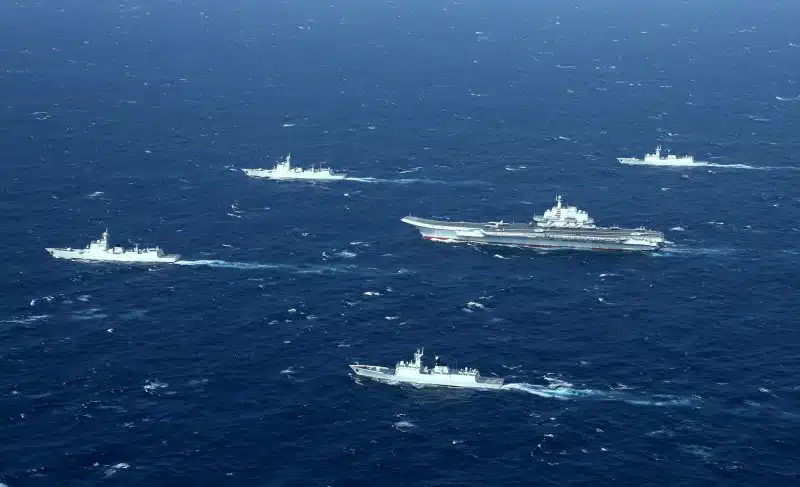
Recent reports reveal China’s strategic preparations for a potential military operation against Taiwan, emphasizing its significant naval capabilities. The Telegraph highlights China’s impressive shipbuilding industry, which is estimated to be 200 times more productive than that of the United States, despite a smaller military budget. With a current fleet of 405 warships compared to the U.S. Navy’s 295, experts warn that China’s ambitions in the Taiwan Strait are growing increasingly formidable.
China’s Maritime Strategy and Military Modernization
China’s military modernization has shifted focus from land to maritime domains over the past three decades. Ridzwan Rahmat, a principal defense analyst at Janes, notes that the existential threats China faces have increasingly come from the sea, prompting a significant investment in naval capabilities. The country’s defense priorities now center around territorial disputes in the South China Sea and its claims over Taiwan, which lies just 100 miles away.
President Xi Jinping has made the “reunification” of Taiwan a cornerstone of his administration, frequently reiterating Beijing’s goal of asserting control over the island. Recent comments from Japan’s new Prime Minister, Sanae Takaichi, suggesting that a conflict over Taiwan could involve Japanese military action, have heightened tensions, drawing sharp responses from Beijing. Additionally, a recent $11 billion arms package from the U.S. to Taiwan has further aggravated China.
Despite the People’s Liberation Army (PLA) Navy’s extensive fleet, experts like Tom Shugart, a former U.S. submarine officer, caution that the current number of amphibious assault ships is insufficient for a full-scale invasion. Instead, China has been enhancing its dual-use shipbuilding capabilities, equipping civilian vessels with military technology. Since 2015, all new civilian ships have been designed for potential military use, allowing China to leverage its civilian fleet for military operations in emergencies.
China’s shipbuilding strategy includes the production of various types of vessels, such as roll-on/roll-off ships capable of transporting military equipment. The U.S.-based Center for Strategic and International Studies (CSIS) estimates that China will complete around 200 of these ships between 2023 and 2026, significantly increasing its logistical capabilities for any potential operation against Taiwan.
Potential Scenarios for Conflict and Challenges Ahead
Experts predict that any military action against Taiwan would likely begin with cyberattacks and moves against critical infrastructure, aiming to disrupt Taiwan’s communication systems. Alexander Huang, chairman of the Council on Strategic and Wargaming Studies, outlines two potential strategies: a cyber assault to weaken Taiwan quickly or a maritime quarantine to cut off the island’s energy and communication supplies gradually. Given Taiwan’s reliance on imports for energy and food, such tactics could have devastating effects.
China has been conducting extensive military drills around Taiwan, simulating various scenarios to prepare for potential conflict. Recent exercises involved deploying hundreds of ships and aircraft, demonstrating China’s commitment to showcasing its military strength. However, experts remain skeptical about China’s ability to successfully execute a landing operation due to challenging maritime conditions in the Taiwan Strait, which is known for strong winds and high waves.
While China has developed specialized barges for potential landings, experts warn that many of Taiwan’s beaches may be unsuitable for such operations due to environmental changes and coastal development. Taiwan’s Ministry of National Defence actively monitors potential landing sites, but specific risks remain undisclosed.
As China continues to enhance its naval capabilities, including the recent launch of advanced aircraft carriers, the scale of its military preparations raises significant concerns. With thousands of ships potentially involved in any landing campaign, experts emphasize the need for vigilance in monitoring China’s military developments in the region.
