
Chinese Cargo Ship Sparks Military Concerns
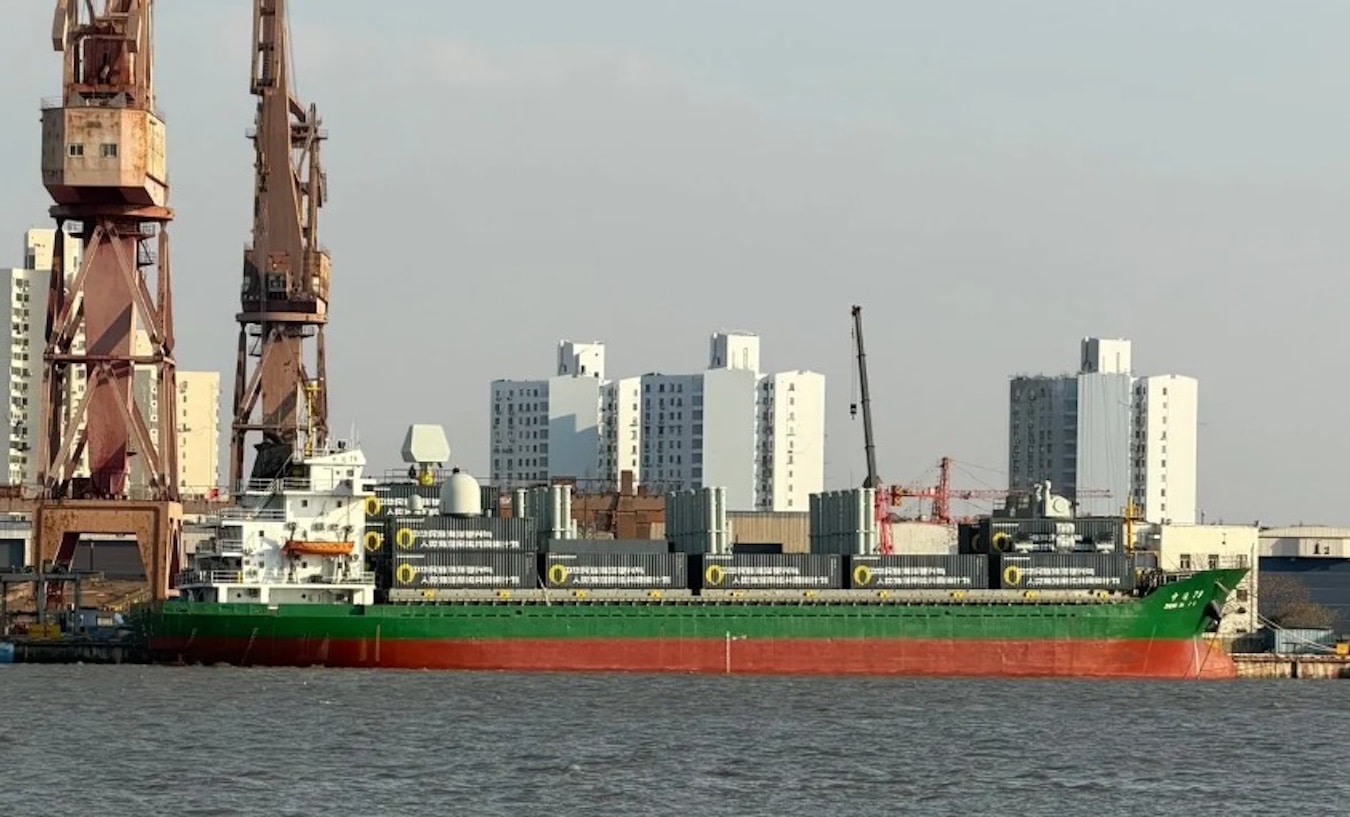
Recent photographs taken during the Christmas period have unveiled a civilian-style cargo ship at the Hudong–Zhonghua shipyard in Shanghai, reportedly equipped with military systems. Analysts have identified containerized missile launchers, advanced sensors, and point-defense hardware on the vessel, raising alarms about the blurred lines between commercial and military maritime operations. This sighting has ignited a broader discussion regarding China’s military-civil integration and its implications for regional security.
What The Photos Show
The newly released images of the cargo ship, taken at the Hudong–Zhonghua Shipyard, have caught the attention of defense analysts. The ship appears to be outfitted with containerized missile launchers and advanced sensors, along with turret-like mounts that suggest short-range defense capabilities. Experts who have analyzed the photographs note that the arrangement of launcher-sized containers on the deck aligns with known concepts of containerized military systems, which can fit into standard cargo modules.
While the external features of the ship cannot definitively confirm the specific military systems installed, the visible layout raises significant concerns. The ship’s presence at a facility known for constructing major naval vessels indicates potential military trials or integration efforts. This development highlights the ongoing trend of military-civil integration in China, where commercial technologies are increasingly adapted for defense purposes. As such vessels could easily blend into regular merchant traffic, they complicate threat detection and raise questions about maritime engagement rules.
Strategic Context: Dual-Use at Sea
China has long advocated for military-civil integration, promoting the use of commercial technologies to bolster national defense. Observers have noted the rapid expansion of auxiliary and militia fleets, as well as the adaptation of civilian vessels for various military roles, including surveillance and logistics. The Hudong–Zhonghua Shipyard, part of the China State Shipbuilding Corporation, has a history of delivering significant amphibious ships and combat vessels. The emergence of a cargo ship with apparent military capabilities at this site suggests that the Chinese military is exploring new operational strategies.
The implications of weaponized civilian vessels are profound. Such ships can operate under the guise of commercial traffic, making it challenging for naval forces to distinguish between civilian and military intentions. This ambiguity could escalate tensions in contested waters, particularly in the South and East China Seas, where misidentification of vessels could lead to unintended confrontations. For the United States and its allies, adapting to this evolving maritime landscape may necessitate new identification techniques and enhanced integration of commercial shipping data with military intelligence.
Why Containerized Launchers Matter
The use of containerized systems allows for the concealment of missiles or drones within standard shipping containers, facilitating rapid deployment and providing a level of deniability. A ship that appears commercial can approach conflict zones without raising alarms, posing a significant challenge to maritime patrols and increasing the risk of surprise attacks. Several nations have experimented with container-based launchers for coastal defense and covert operations, leveraging existing logistics networks and port infrastructure.
If China successfully implements this capability on a large scale, it could fundamentally alter naval strategies in the Western Pacific. Analysts express concern that weaponized merchant vessels could jeopardize the safety of civilian shipping lanes, leading to heightened scrutiny of ordinary cargo ships and potentially disrupting maritime trade. However, some experts caution against drawing definitive conclusions based solely on photographs, suggesting that the vessel may serve as a test platform rather than a fully operational military unit.
Implications for Regional Security
The integration of military capabilities into civilian maritime traffic complicates crisis management in sensitive regions. Coast guards and naval forces may face critical decisions regarding vessels that appear commercial but may harbor military intentions. This uncertainty could escalate localized incidents into broader conflicts, necessitating a reevaluation of engagement protocols.
For the United States and its allies, tracking dual-use vessels will likely require innovative identification methods and a more comprehensive approach to merging commercial shipping data with military surveillance. Additionally, discussions surrounding maritime law and the status of disguised ships during peacetime and conflict may need to be revisited to address these emerging challenges.
Signals To Watch
– Increased sightings of similar containerized layouts on additional vessels.
– Port activities indicating rapid loading of launcher-sized containers onto civilian ships.
– Official announcements or procurement notices related to containerized maritime systems.
– Military exercises involving cargo-style vessels in combat scenarios.
What Comes Next
Should China continue to develop weaponized civilian hull concepts, neighboring countries may respond with stricter port inspections, enhanced surveillance, and fortified coastal defenses. Shipping companies could face new compliance requirements as authorities seek to verify cargoes and vessel configurations. Insurers may also need to adjust risk assessments for ports located near sensitive military installations.
No oil sightings arising from oil-releated incidents Precautionary measures to stand down from today
The recent images provide a rare glimpse into how a major shipyard might be experimenting with modular launchers and layered defenses on unconventional platforms. While the extent of deployment remains uncertain, this sighting aligns with a broader trend of flexible, low-signature maritime capabilities. Naval strategists must now reconsider the assumption that cargo vessels are benign, as the distinction between commercial and military ships continues to blur. Observers should remain vigilant for further imagery, maritime advisories, and training activities that could clarify whether this is an isolated incident or indicative of a larger shift in naval operations.
