
Deadly Cargo Ship Collision Deemed “Wholly Avoidable”
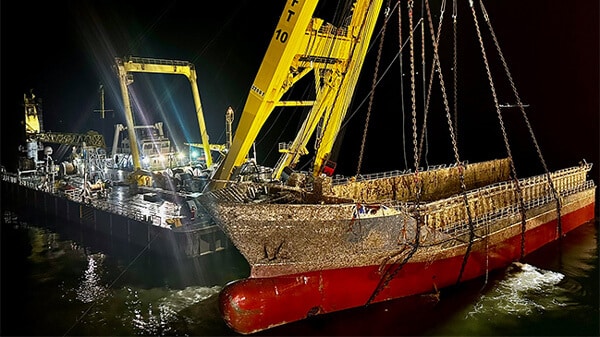
The UK’s Marine Accident Investigation Branch (MAIB) has released its final report on the tragic collision between two cargo ships in the North Sea, which occurred in October 2023. The report labels the incident as “wholly avoidable,” criticizing the reckless behavior of both crews and the German Bight vessel traffic service. The accident resulted in the loss of five seafarers aboard the Isle of Man-registered ship Verity, which sank within minutes of the collision.
Details of the Collision
The collision took place on October 24, 2023, at approximately 0500 hours, involving the Verity and the Bahamas-registered bulker Polesie. The Verity, a smaller cargo ship built in 2001, was carrying 3,262 tonnes of steel coils and had departed Germany en route to the UK with a crew of seven. Meanwhile, the Polesie was transporting 32,997 tonnes of feed barley and wheat from Germany to Spain, with a crew of 20 on board. The two vessels collided at a speed of 12 knots, resulting in significant damage to the Verity, which suffered a large breach in its hull and sank in less than five minutes.
Despite the crew’s efforts to muster after the accident, they were unable to don survival suits in time. Tragically, five crew members lost their lives, including the captain, whose body was later recovered. The remaining four crew members are still missing. Following the incident, the Verity was salvaged and inspected as part of the investigation.
Investigation Findings and Recommendations
The MAIB conducted a thorough investigation, culminating in an extensive 82-page report. The report highlights that the Verity lacked a Voyage Data Recorder due to its age and size, which hindered the investigation. Key crew members had perished, limiting the ability to fully understand the decisions made by the watchkeeper on the Polesie and the German Bight vessel traffic services. However, the investigation was able to reconstruct many actions and conversations, revealing significant shortcomings in the watchkeepers’ adherence to the International Regulations for Preventing Collisions at Sea.
According to the MAIB, both watchkeepers accepted dangerously close passing distances, despite having ample room to maneuver. The report emphasizes that early communication via very high-frequency radio could have clarified each vessel’s actions, potentially preventing the collision. Furthermore, the vessel traffic service’s late intervention and failure to use standard marine communication phrases contributed to the severity of the situation. The MAIB criticized the second attempt at intervention as “counterproductive” due to its timing.
In light of these findings, the report recommends that shipping companies reinforce compliance with navigational regulations and standards. It also calls for the German Directorate General for Waterways and Shipping to review duplex VHF radio channels and improve communication protocols. Lastly, the Isle of Man Ship Registry is urged to propose extending Voyage Data Recorder requirements to the International Maritime Organization. The MAIB concluded that the issues stemmed not from regulatory failures but from a lack of adherence to established maritime protocols.
