
Japan Unveils Ambitious Hydrogen Carrier Project
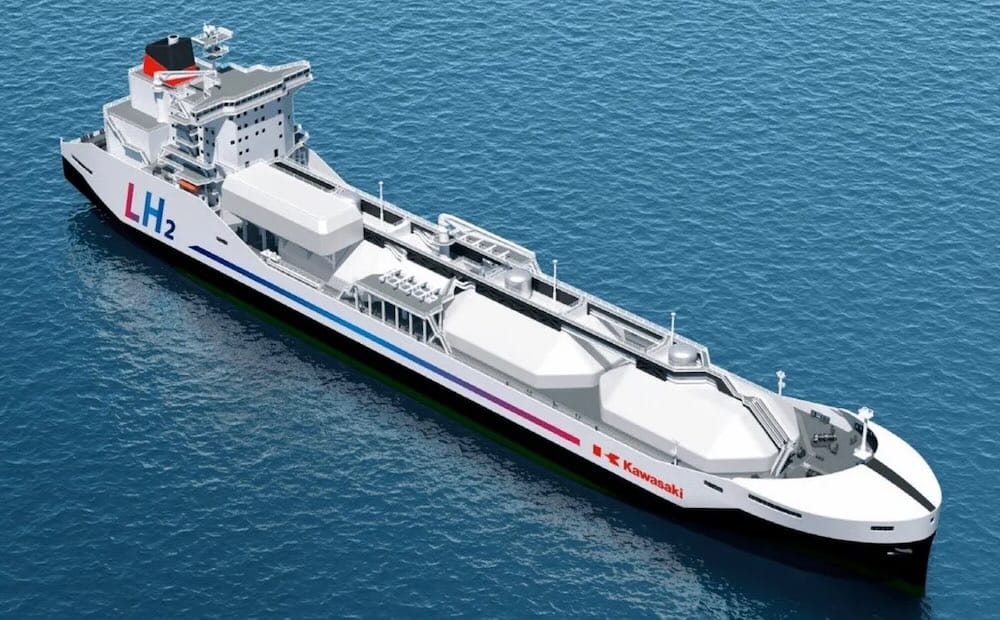
Japan is making significant strides in the hydrogen economy by planning to construct the world’s largest liquefied hydrogen carrier. This initiative aims to establish a commercial-scale supply chain for importing hydrogen, marking a pivotal shift from experimental phases to practical implementation. The project is backed by the government’s Green Innovation Fund and involves a collaboration between Kawasaki Heavy Industries and Japan Suiso Energy.
Major Developments in Hydrogen Transportation
Kawasaki Heavy Industries (KHI) has joined forces with Japan Suiso Energy (JSE) to develop a liquefied hydrogen (LH2) carrier with a capacity of 40,000 cubic meters. This new vessel will significantly surpass the 1,250 cubic meter experimental ship used in earlier trials, showcasing Japan’s commitment to advancing its hydrogen infrastructure. This project comes four years after the successful demonstration of the world’s first liquefied hydrogen carrier, the Suiso Frontier, and signals a transition from trial to commercial operations.
The carrier is central to the Green Innovation Fund Project, which is backed by Japan’s New Energy and Industrial Technology Development Organization (NEDO). With an investment of approximately $2 billion, this project aims to establish a comprehensive liquefied hydrogen supply chain that includes production, storage, marine transport, and delivery. JSE, which was founded in 2021 to enhance Japan’s hydrogen import capabilities, will lead the initiative, while KHI will construct the vessel at its Sakaide Works.
This state-of-the-art carrier is expected to measure around 250 meters in length and operate at a service speed of 18 knots. Demonstration voyages, which will include loading and unloading operations, are anticipated to start by 2030. The vessel will incorporate advanced insulation technology to minimize boil-off gas, along with double-wall vacuum-jacketed piping designed for ultra-low-temperature transfer. Additionally, its propulsion system will utilize hydrogen boil-off as fuel, enhancing efficiency.
DNV awards AiP to HD KSOE’s hydrogen system for liquefied hydrogen carrier
Supporting Infrastructure for Hydrogen Import
In conjunction with the new carrier, the project will also see the construction of a commercial-scale liquefied hydrogen terminal at Ogishima in Kawasaki City. This facility will feature a substantial 50,000 cubic meter storage tank, with groundbreaking having commenced in November 2025. The terminal will play a crucial role in supporting the hydrogen supply chain, ensuring that Japan is well-equipped to meet future energy demands through sustainable sources.
Japan’s initiative to build the largest liquefied hydrogen carrier and supporting infrastructure signifies a crucial step towards a more sustainable energy future. By investing in hydrogen technology, Japan aims to position itself as a leader in the global hydrogen economy, paving the way for cleaner energy solutions and a reduced carbon footprint.
