
Significant Oil Traffic Resumes Through Strait of Hormuz
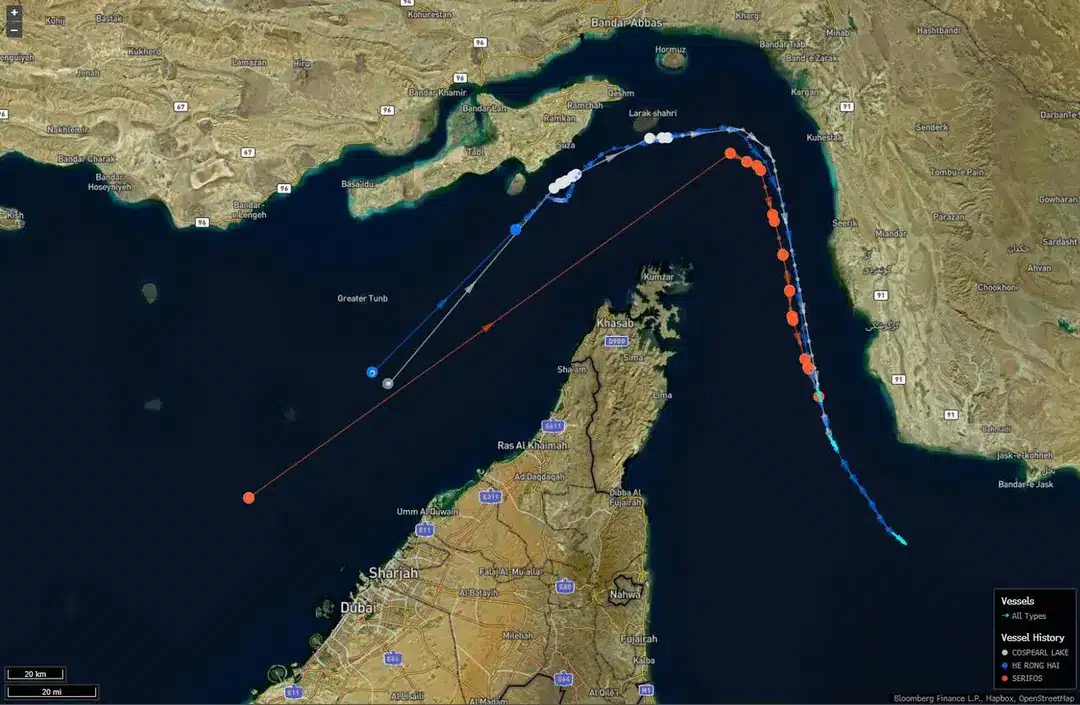
The Strait of Hormuz has seen a notable increase in oil shipping traffic as two Chinese supertankers successfully navigated the waterway on Saturday, following a period of stagnation due to ongoing regional conflicts. This marked the first significant movement of oil tankers through the strait since the war began on February 28, which had previously caused a near-total halt in maritime traffic. The two Chinese vessels, the Cospearl Lake and the He Rong Hai, departed shortly after a Greek tanker, the Serifos, made its crossing. Notably, none of these ships are transporting Iranian oil or have direct ties to Iran, highlighting a shift in the dynamics of oil transport in the region.
The Cospearl Lake and He Rong Hai loaded their crude cargoes in Saudi Arabia, while the Serifos also sourced its load from the same country. Tracking data indicates that all three tankers took a newly designated route south of Iran’s Larak Island, a path recently outlined by the Iranian navy. By Saturday morning, the vessels were reported to be in the Gulf of Oman, signaling a potential resurgence in oil trade through this critical maritime corridor.
Impact on Global Oil Supply and Market Dynamics
The resumption of tanker traffic through the Strait of Hormuz is being closely monitored by marine and oil industry analysts, as it could indicate a broader recovery in oil shipments. However, despite the significance of this development, the volume of oil being transported remains considerably below pre-war levels. The three tankers combined have a transport capacity of approximately 6 million barrels of crude oil. In contrast, Iran had been exporting around 1.7 million barrels per day last month, suggesting that current shipments are only a fraction of normal operations.
Revolution Wind Project Receives Legal Green Light to Resume Operations
Iran has stated that vessels can pass through the strait, provided they obtain permission. The three tankers adhered to a northern route through the strait, which passes through Iranian waters and is aligned with Tehran’s requirements. This route diverges from the traditional shipping lanes that hug the southern coast of the waterway. The Greek tanker, the Serifos, is reportedly heading towards Malacca in Malaysia, a key waypoint for vessels traveling to various destinations in Asia.
The Strait of Hormuz is a vital artery for global oil trade, accounting for about 20% of the world’s oil supply and a similar portion of liquefied natural gas. The recent increase in tanker movements is crucial for alleviating the pressure on global oil markets, which have been strained by the conflict. The reopening of this strategic waterway could lead to a significant reduction in oil prices, benefiting economies reliant on stable energy supplies. As the U.S. and Iran prepare for peace talks in Islamabad, the future of oil transport through Hormuz remains a critical focus for international stakeholders.
