
Teledyne’s FLIR Cameras Enhance Nighttime Safety for Mariners
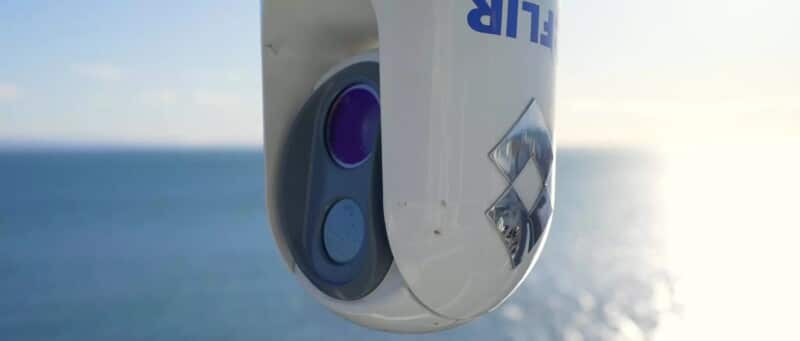
On February 5, 2026, Teledyne unveiled its advanced FLIR camera technology, designed to significantly improve safety for mariners navigating at night. With the ability to detect objects and people in complete darkness, these cameras are becoming essential tools for fishermen and other maritime professionals. Eric D’Ancicco, regional sales manager for FLIR, emphasized that safety is the primary motivation behind the growing demand for these devices. “If it’s going to increase my chance of survival by even 20 percent, I want it,” he stated, highlighting the critical role these cameras play in emergency situations, such as man overboard (MOB) incidents.
The FLIR camera systems can detect temperature differences as small as a fraction of a degree, allowing users to spot floating objects, including logs and buoys, that would otherwise be invisible at night. D’Ancicco demonstrated the camera’s capabilities by showing how it could capture the impression of a handprint on a book, even 25 pages deep. This technology proved invaluable during the Deepwater Horizon oil spill, enabling continuous nighttime cleanup operations by detecting oil on the water’s surface.
Versatile Applications and User-Friendly Design
Teledyne markets FLIR camera systems to a diverse clientele, including military, commercial vessels, and private yacht owners. Beyond enhancing safety and preventing collisions, these cameras provide fishermen with improved situational awareness in crowded fishing areas. D’Ancicco explained that the infrared images captured by FLIR cameras can be displayed on any multifunction display (MFD), offering users a clearer understanding of nearby vessel activities.
The range of FLIR cameras varies by model, with the base model, M232, capable of detecting objects up to one mile away, while the top-tier M500 military-grade model extends this range to five miles. Prices for these systems start at $3,000, and D’Ancicco reported selling three units at the 2025 Pacific Marine Expo. He noted that while feedback from fishermen primarily focused on safety and collision avoidance, the presence of FLIR cameras on boats in Seattle’s Ballard area indicates their growing popularity.
Installation of the FLIR cameras is straightforward, requiring only a plastic base, four bolts, and two wires connected to the MFD. The camera can rotate 360 degrees, providing comprehensive coverage for users. For fishermen seeking enhanced safety and visibility during nighttime operations, Teledyne’s FLIR solutions offer a reliable and effective option.
