
US Navy Christens Final Fast Transport Ship
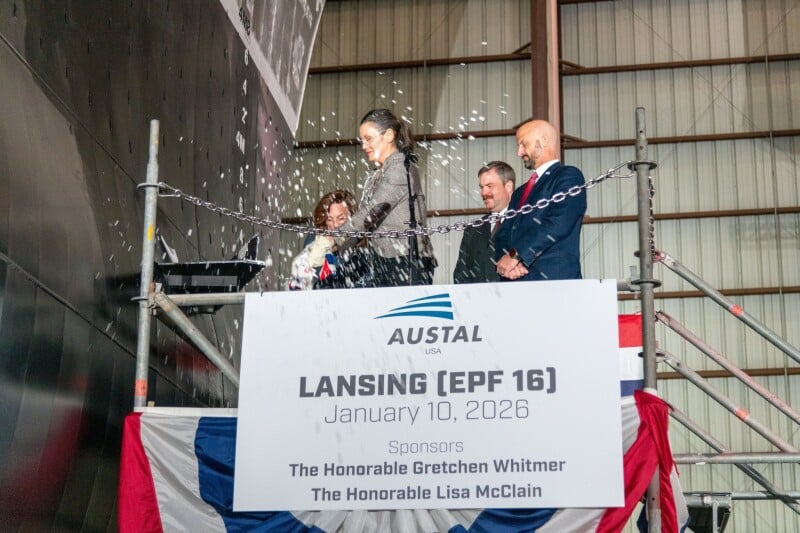
On January 10, the U.S. Navy celebrated a significant milestone with the christening of the USNS Lansing (EPF 16) at Austal USA’s shipyard in Mobile, Alabama. This event marks the completion of the Flight II expeditionary fast transport (EPF) program, which has been instrumental in enhancing the Navy’s logistical capabilities. The ceremony featured notable sponsors, including Michigan Governor Gretchen Whitmer and U.S. Representative Lisa McClain, who jointly blessed the ship, symbolizing its importance to national defense.
Significance of the USNS Lansing
The USNS Lansing is the last vessel in the Flight II EPF series, designed to provide high-speed, shallow-draft transport for personnel and cargo. These ships are crucial for rapid response operations and global mission support. During the christening ceremony, both sponsors broke champagne bottles on the ship’s bow, declaring, “For the United States of America, I christen thee Lansing. May God bless this ship and all who sail in her!” This moment underscored the ship’s role in enhancing the Navy’s operational capabilities.
Austal USA President Michelle Kruger emphasized the significance of the event, stating, “I was especially honored to witness this tradition that means so much to our Navy and our Nation with the christening of the last ship of this great fleet.” She highlighted the enhanced capabilities of the Flight II ships, which are designed to support various missions, including medical operations and troop transport. The shipbuilding effort has involved a dedicated team committed to delivering high-quality vessels to the Navy.
Key speakers at the event included Hung Cao, Under Secretary of the U.S. Navy, and Rear Adm. Benjamin Nicholson, Commander of Military Sealift Command. Cao remarked on the importance of the shipyard workers’ craftsmanship and the transition from construction to rigorous testing and trials, ensuring the ship is ready for operational demands.
Technical Features and Future Operations
The USNS Lansing is notable for being the first Navy ship named after Michigan’s capital. It boasts a length of 337 feet and a width of 93 feet, featuring enhanced medical capabilities, including surgical facilities and an intensive care unit. The ship’s catamaran design ensures stability during medical procedures while underway, making it a versatile asset for the Navy.
Flight II vessels are equipped to support Distributed Maritime Operations and Expeditionary Advanced Base Operations, while retaining the logistics and transport capabilities of earlier EPF variants. The EPF program has delivered a fleet of 16 Spearhead-class vessels since its inception, with 11 currently in service. The successful completion of this program underscores the Navy’s commitment to modernizing its maritime logistics and expeditionary operations.
Looking ahead, Austal USA has secured a $868 million contract to design and construct three expeditionary medical ships based on the EPF design, further expanding the Navy’s capabilities in maritime operations.
