
Venezuela’s Maritime Landscape Faces Transformation Amid Rising Risks
Venezuela’s maritime environment is experiencing significant changes, marked by a surge in unconventional vessel activities over the past year. This transformation involves foreign strategic actors, transnational criminal organizations, and offshore commercial networks, all contributing to a more opaque maritime landscape. The evolving dynamics are driven by sanctions, geopolitical shifts, and an increased U.S. naval presence, altering how both state and non-state actors operate at sea.
Historically, Venezuela’s waters have been associated with economic strain and established smuggling routes. However, recent patterns indicate a shift towards longer, indirect voyages aimed at evading detection rather than facilitating trade. Traditional narcotics corridors are adapting under enforcement pressure, leading to a fracturing of established routes. Moreover, offshore waters, previously dominated by oil-related ship-to-ship operations, are now witnessing a broader mix of vessel types and cargoes, complicating supply chains and obscuring cargo movements.
The implications of these developments are profound. Behaviors once considered anomalies, such as extended loitering at sea and multi-stage ship-to-ship transfers, are becoming commonplace. Venezuela’s maritime domain is evolving into a hub for strategic logistics and covert operations, raising concerns about the increasing risks associated with maritime activities in the region.
Emerging Patterns of Foreign Strategic Actors
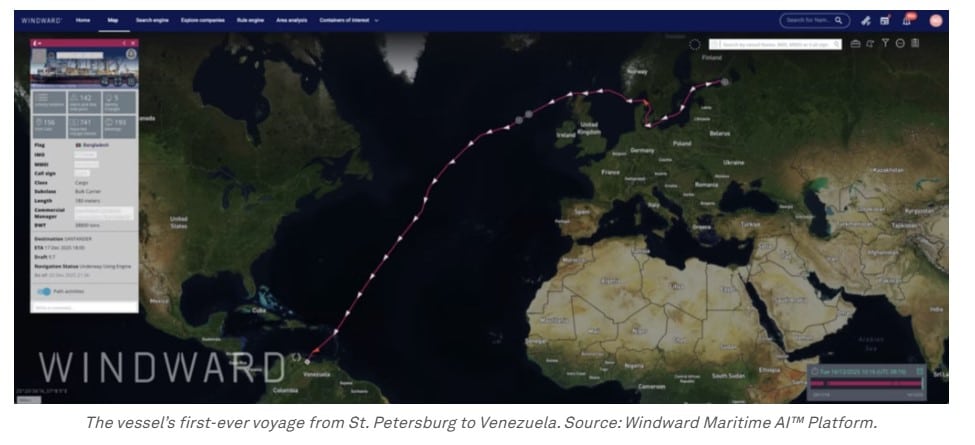
A notable trend in Venezuela’s maritime activities involves the increasing presence of foreign strategic actors, particularly from Russia. Recent reports highlight a concerning pattern characterized by first-time voyages and direct routes from Russian ports to Venezuela. A significant example is a Bangladesh-flagged bulk carrier that made its inaugural trip to Venezuela, departing from St. Petersburg, a key port for Russian government and defense-related shipments.
The vessel’s direct journey to Puerto Cabello, Venezuela’s largest commercial port and a vital naval facility, raises questions about the nature of its cargo. While bulk carriers are not typically associated with weapons transport, the geopolitical context suggests a potential for sanctioned or dual-use commodities being moved under the guise of legitimate trade. Windward’s AI-driven risk model flagged this vessel as a moderate risk for smuggling, based on unusual loitering patterns and its first-time entry into Venezuelan waters.
Further analysis revealed additional vessels with similar patterns, indicating the emergence of an informal logistics corridor between Russia and Venezuela. This trend underscores the deepening military and political ties between the two nations, as Venezuela increasingly relies on Russian support amid heightened U.S. naval activity in the region.
Rising Smuggling Operations and Coordinated Activities
Venezuela’s waters are becoming a focal point for smuggling operations, as evidenced by a sharp increase in ship-to-ship activities involving vessels flagged with smuggling risk indicators. Windward’s Early Detection solution reported a 65% rise in such behaviors within Venezuela’s Exclusive Economic Zone (EEZ) since April 2025. The activity peaked towards the end of the year, with 37 vessels conducting 173 ship-to-ship meetings in a concentrated area between Venezuela and Trinidad and Tobago.
Remote sensing intelligence corroborates these findings, revealing coordinated rendezvous among vessels of various flags and types, indicative of high-risk operations. Satellite imagery captured in December illustrated how these meetings unfold, with multiple vessels gathering in patterns consistent with known smuggling tactics. The presence of unregistered micro-vessels alongside larger cargo ships suggests a deliberate strategy to obscure illicit cargo movements.
The complexity of these operations reflects a well-established offshore logistics network designed to facilitate the movement of goods while evading increasing U.S. maritime enforcement. The combination of behavioral analytics, remote sensing imagery, and vessel tracking is essential for authorities to understand the evolving smuggling infrastructure in Venezuela’s maritime domain.
As Venezuela’s waters continue to transform into a hub for covert maritime activity, the need for enhanced visibility and early detection becomes paramount. The integration of multi-source intelligence will be crucial in navigating the complexities of this shifting maritime landscape.
