
Ship Wreck: Arniston and the Wreck That Cost Almost Everyone Aboard
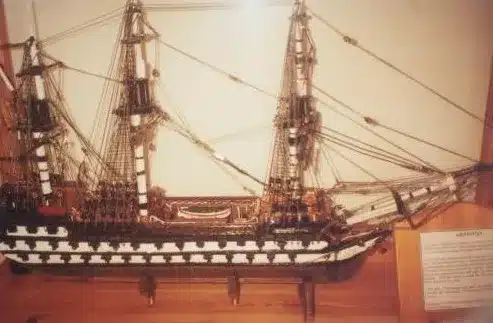
Arniston was a British East Indiaman, a large armed merchant ship that sailed for the East India Company. She is best known for her wreck in May 1815 near Cape Agulhas in South Africa, when she was carrying invalid soldiers home from Ceylon and only six people on board survived. The loss of this East Indiaman is a well-documented example of how navigation without reliable longitude could end in disaster.
Principal Particulars
The source gives few physical dimensions, so the list below is short.
- Builder, William Barnard at Barnard’s Thames Yard, Deptford
- Launched, 1794
- Armament, 58 guns
- Owner for early voyages, John Wedderburn, probably of Ballindean
- Owner for later East India Company voyages, Robert Hudson
Building the East Indiaman
Arniston was built by William Barnard at his yard on the Thames at Deptford and launched in 1794. She was probably named after Lord Arniston rather than the small village near Edinburgh. As an East Indiaman she carried 58 guns, which made her roughly the equivalent of a Royal Navy fourth-rate ship of the line. The armament was there to protect her cargo from pirates and privateers during long voyages between Europe and the Far East.
Vessels of this kind were built to carry large cargoes rather than to be fast or handy. Like other East Indiamen, Arniston was slow and hard to manoeuvre, but she could hold a great deal of goods. In general terms, wooden ships of this period were framed and planted with oak, caulked along the seams and fastened with treenails and iron bolts. Such hulls were buoyant and comparatively cheap to build, but they were prone to rot, shipworm and leaking in heavy seas, and they needed regular maintenance.
Voyages for the Company
Arniston sailed to the Far East eight times before her last voyage. Her early runs took her to St Helena, the Cape of Good Hope, Madras, Penang, Malacca, Whampoa and Macau, and most of these passages were uneventful. On one homeward journey from China she struck an uncharted rock near the island of Pulo Goondy, just south of Sumatra. She suffered no ill effects, and the incident was noted in journals of the time mainly as a hazard to other shipping.
In 1795 she carried troops from St Helena to join Lord Elphinstone’s expedition against the Dutch at the Cape. She also took on four field guns that George Vancouver, returning from his voyage of exploration, passed to her for onward delivery. During her 1800 visit to Benkulen she was attacked by the French privateer Confiance. Arniston cut her anchor and gave chase, firing several broadsides, but the faster French ship escaped. Her later voyages to China in 1804 and 1812 were made under letters of marque. In 1812 the British government chartered her as a troop transport to the Cape and India.
The Final Voyage and Its Navigation
On her last voyage, Captain George Simpson left England in June 1814 and took on soldiers of the 73rd Regiment at Ceylon. These men had been wounded in the Kandyan Wars and were being taken home. Arniston sailed from Galle on 4 April 1815 in a convoy of six other East Indiamen, escorted by HMS Africaine and HMS Victor. Among her 378 passengers were many invalid soldiers and sailors, along with 14 women and 25 children.
A central issue in the loss was that the ship had no marine chronometer. This instrument was a fairly new aid to finding longitude and was not expensive at the time, but Captain Simpson could not afford one and the owners would not buy one. During the passage the convoy exchanged daily longitude readings taken from their chronometers, so the master could check his own position while he stayed with the fleet.
On 26 May, while rounding the southern tip of Africa in bad weather, Arniston became separated from the convoy after her sails were damaged. Without the daily longitude readings from the other ships, she depended on dead reckoning and older methods. Strong currents and poor weather prevented a celestial fix for several days. Navigational difficulties and slow progress led to the mistaken belief that Cape Agulhas was Cape Point. The captain then headed north for St Helena on the understanding that the ship had already passed Cape Point, and on 30 May 1815 she was wrecked during a storm at Waenhuiskrans near Cape Agulhas, with the loss of 372 lives.
How Such Losses Commonly Happen
This section describes how vessels of this type are commonly lost in comparable conditions. It is not a statement about what happened aboard this particular ship beyond what is recorded above. A sailing vessel of this size and rig can be pushed toward a lee shore by wind and current, and leeway can carry her sideways faster than her crew expects. Her lateral resistance, the grip of her hull against that sideways motion, depends on draught and sail set. When position is uncertain, the danger grows, because a ship may believe she is further from land than she really is.
Wave steepening in shallow water can make a coast far more dangerous than open sea. A large, heavily laden ship with limited reserve buoyancy and slow handling has little room to correct a mistake once close to shore. In general, wooden hulls can work in heavy weather and open their seams, and a ship in that state may take on water faster than the pumps can clear it. Ground tackle, steering under reduced canvas and the difficulty of finding an anchorage in storm conditions all add to the risk.
What Might Have Helped
These are general measures that reduce the risk of this kind of loss. They are not a claim about what this particular ship lacked. Reading the weather early, gaining sea room, shortening sail in good time and choosing between tacking and wearing all help a ship keep clear of a dangerous coast. Carrying sound ground tackle, enough cable, kedge anchors and working pumps also matters, as does an accurate position from celestial observations or a reliable timekeeper.
Design and loading play their part too. Adequate freeboard, sound ballast, tight hatches and properly secured cargo keep a vessel stable and dry. For contrast, modern vessels carry engines that allow them to claw off a lee shore, satellite positioning that fixes longitude without a chronometer, and forecasts that warn of storms well in advance.
Terms Definition
Dead reckoning is a method of estimating a ship’s position from her last known point, her course, her speed and the time elapsed. It is useful but is open to error when currents or leeway are strong.
Chronometer refers to a precise clock carried aboard ship. Comparing its reading with local time allows a navigator to work out longitude, which is why its absence mattered so much on this voyage.
Letter of marque was a licence that allowed a privately owned armed ship to act against the enemy’s trade in time of war. Many East Indiamen carried one for their protection.
