
The Physics of a Capsize: Positions of G and M in an Unstable Ship
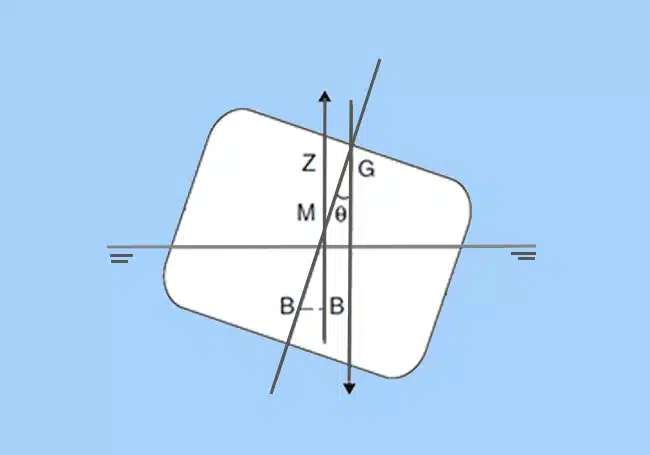
When you watch a massive cargo vessel slice through ocean waves, you are witnessing a masterful balancing act. A ship’s ability to stay upright doesn’t happen by chance; it relies on the strict physical relationship between two invisible but critical points: the Center of Gravity (G) and the Metacenter (M). As long as these two points remain in their proper positions, the ship can endure massive storms. However, if a vessel is loaded incorrectly, the relationship between these points flips, creating a highly dangerous condition known as unstable equilibrium.
To truly understand why a ship rolls over, we must look closely at what happens to the positions of G and M in an unstable ship.
The Baseline: Understanding the Roles of G and M
Before we look at a ship in distress, we first need to understand how these points behave in a perfectly safe, stable vessel.
The Center of Gravity (G) is the exact central point where the total downward weight of the ship and all its cargo is concentrated. Gravity pulls straight down through this point. The Metacenter (M) is a bit more abstract. When a wave pushes a ship to lean to one side, the underwater shape of the hull changes, and the upward push of the water shifts. The Metacenter (M) is essentially the invisible “pivot point” or hinge high up in the ship where these shifting upward forces intersect.
In a safe, stable ship, the Metacenter (M) must always remain sitting higher than the Center of Gravity (G). You can think of this relationship exactly like a heavy pendulum swinging from a grandfather clock. The hinge at the top of the clock is M, and the heavy brass weight hanging at the bottom is G. Because the heavy weight (G) is suspended well below the pivot point (M), whenever you push the pendulum to the side, it naturally wants to swing right back to the center. This vertical distance between the two points is called the Metacentric Height (GM). As long as G is below M, the ship will always fight to pull itself upright.
The Dangerous Shift: When G Rises Above M
The core of maritime instability happens when this crucial relationship is reversed. If a ship is loaded improperly—perhaps by stacking too many heavy shipping containers high up on the main deck while leaving the lower cargo holds empty—the Center of Gravity (G) is physically pulled upward. If the crew is not careful, G will rise so high that it actually passes above the Metacenter (M).
When we ask what happens to the positions of G and M in an unstable ship, the definitive answer is that G moves above M. In naval architecture, this is known as having a “negative Metacentric Height” (a negative GM).
When G sits above M, the pendulum effect is completely destroyed. Instead of a heavy weight hanging safely beneath a pivot point, you now have a heavy weight balancing precariously on top of a pivot point. Imagine taking a heavy sledgehammer, turning it upside down, and trying to balance the heavy metal head on the palm of your hand. It might stay there if you are perfectly still, but the absolute slightest breeze will cause the heavy top to drag the whole thing down. When a wave hits a ship with G above M, the downward pull of gravity and the upward push of the water no longer work together to right the ship. Instead, they twist together to violently pull the ship further over, creating a capsizing moment.
The Real-World Consequences: The Angle of Loll
When an unstable ship with G above M is pushed sideways by the wind, it does not immediately flip completely upside down in a split second. Because the shape of a ship’s hull curves outward, as the ship heels over dangerously, the underwater mechanics begin to change rapidly.
As the vessel flops over, the upward push of the water shifts dramatically outward. If the ship is lucky, this massive outward shift will temporarily create a new, temporary Metacenter that aligns with the high Center of Gravity. When the ship catches itself at this severe, tilted angle, it is called an “Angle of Loll.” The ship will remain stuck leaning heavily to one side, completely unable to return to an upright vertical position.
This is an absolute state of emergency. A ship stuck at an angle of loll is vulnerable to taking on water through its deck hatches or getting tipped the rest of the way by the next wave. Correcting this requires immense skill. The crew cannot simply pump water into any tank to fix it; they must carefully add weight to the lowest possible points on the ship to gently drag the Center of Gravity (G) back down below the Metacenter (M). The strict maritime safety regulations enforced globally are designed specifically to ensure loading computers flag this dangerous G and M relationship before a ship ever leaves the dock, keeping the crew and cargo safe from disaster. Modern organizations, including the United States Maritime Administration (MARAD), constantly emphasize proper weight distribution training for mariners to prevent these precise physical phenomena.
Q&A: The Mechanics of G and M
The position of G (Center of Gravity) is calculated mathematically before the ship sails. The crew uses a loading computer that takes the known empty weight of the ship and adds the weight and exact vertical location of every piece of cargo, fuel, and fresh water loaded aboard to find the combined center point.
Yes, but mostly based on how much the ship is leaning. While the Center of Gravity (G) mostly moves when weight is added, removed, or shifted, the Metacenter (M) moves based on the physical shape of the hull interacting with the waterline. As the ship leans further, the geometry of the underwater hull changes, causing M to shift.
Metacentric height (GM) is simply the vertical distance measured between the Center of Gravity (G) and the Metacenter (M). A positive GM (where M is higher than G) means the ship is stable. A negative GM (where G is higher than M) means the ship is unstable.
This is a fatal mistake. If a ship is at an angle of loll, pumping weight into the high side to “balance” it will actually raise the Center of Gravity (G) even higher. This can cause the ship to violently snap-roll over to the other side, often carrying enough momentum to completely capsize the vessel. Corrective weight must always be added to the lowest possible center tanks first to pull G downward.
