Naval Architecture
-
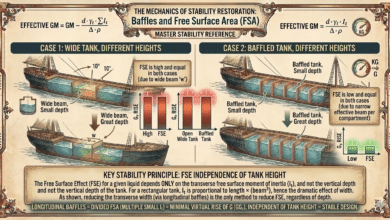
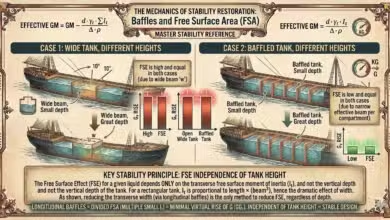
The Depth Illusion: Why FSE Completely Ignores Tank Height?
It sounds crazy: how can a massive, deep tank of sloshing water be just as dangerous as a shallow puddle?…
Read More » -
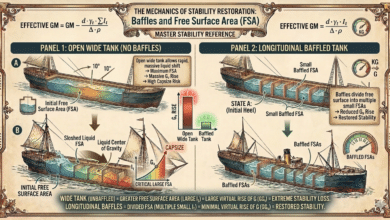
The Steel Solution: What are Longitudinal Baffles and How Do They Reduce FSE?
A wide, partially filled liquid tank is the ultimate enemy of ship stability. Because water and fuel are heavy, allowing…
Read More » -
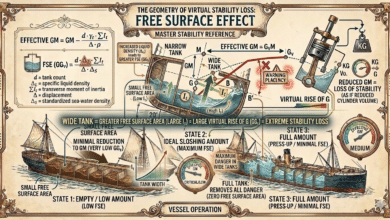
The Cubed Curse: Why a Wide Tank is More Dangerous Than a Narrow Tank Regarding FSE
If you spill a glass of water on the floor, it makes a mess. If you spill a massive swimming…
Read More » -

Heavy Hits: How the Density of the Liquid in the Tank Affects FSE
We already know that the physical depth of the liquid in a rectangular tank does not change the Free Surface…
Read More » -
The Depth Deception: Does the Amount of Liquid Change the Free Surface Effect?
It sounds completely illogical, but maritime physics can be strange. If you have a massive, rectangular fuel tank on a…
Read More » -
The Phantom Weight: How FSE Affects the Effective GM of a Vessel
A ship might look perfectly safe on paper. A deck officer can add up all the cargo weights, calculate the…
Read More » -
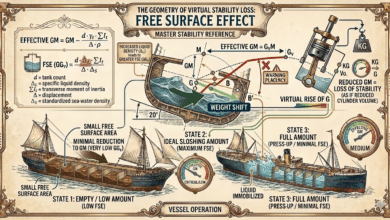
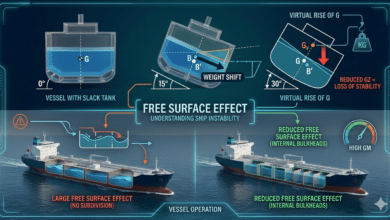
The Enemy Inside: Understanding the Free Surface Effect on Ships
Have you ever tried carrying a wide, shallow baking pan filled to the brim with water? As you walk, the…
Read More » -
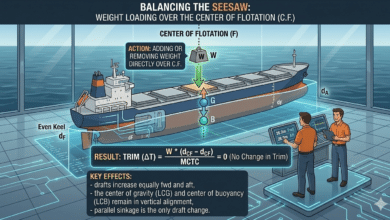
The Perfect Drop: Sinking Straight Down on the Center of Flotation
Imagine a playground seesaw. If you drop a heavy rock on one end, the board violently tilts. But what happens…
Read More » -
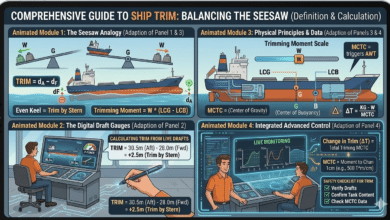
Balancing the Seesaw: Defining Ship Trim and How to Calculate It?
Imagine sitting on a playground seesaw. If you sit perfectly in the middle, the board stays flat. If you slide…
Read More » -
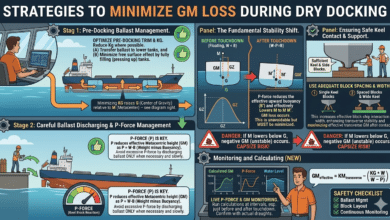
Surviving the Steel Cradle: How to Minimize GM Loss During Dry Docking
Taking a massive ocean liner out of the water is a battle against physics. When the ship enters a dry…
Read More »