
Titanic Tragedy: Local Connections Revealed
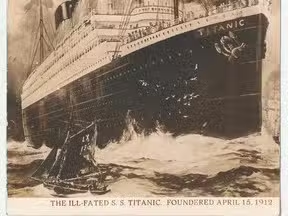
The sinking of the Titanic on April 14, 1912, remains one of history’s most infamous maritime disasters, claiming over 1,500 lives. Recent discoveries at the Stratford-Perth Archives have shed light on local reactions to this tragedy, particularly concerning notable figures such as Charles M. Hays, president of the Grand Trunk Railway, and George E. Graham, a prominent businessman. As the centennial of the disaster approaches, these historical connections remind us of the profound impact the Titanic had on communities far beyond the ocean.
Local Reactions to the Titanic Disaster
The Titanic’s launch was celebrated in local newspapers, but the mood shifted dramatically following its sinking. The Monkton Times reported on April 19, 1912, that the Titanic, hailed as the largest ship ever built, met its fate in the icy waters of the Newfoundland Banks after colliding with an iceberg. Initial reports suggested that all passengers were safe, but the reality soon turned grim as news of the tragedy spread.
In Stratford, the fate of Charles M. Hays was a significant concern. As the head of the Grand Trunk Railway, Hays was a key figure in the community. The Stratford Daily Herald reported on April 18 that hopes for his survival were fading, although his wife was rescued aboard the Carpathia. Similarly, George E. Graham, who had risen through the ranks of the T. Eaton & Co. department store, was also feared lost. His family received conflicting reports about his status, ultimately learning of his death. The community mourned his loss, with many attending his funeral in Toronto, highlighting the personal toll of the Titanic disaster.
Titanic Belfast targets international tourism as profit surges
Uncovering Personal Stories from the Titanic
Among the lesser-known local connections to the Titanic was John Irwin Flynn, a passenger and descendant of Sebastian Fryfogel, the builder of the historic Fryfogel Tavern. Flynn was in New York on business when the Titanic sank. Reports from the Stratford Daily Herald indicated that there was significant anxiety in Shakespeare regarding his fate. Fortunately, Flynn was among the survivors, escaping on a lifeboat with other passengers.
In a 1935 interview, Flynn recounted the harrowing experience of the sinking. He described the chaos and confusion that ensued after the collision, noting that many passengers were reluctant to board the lifeboats, believing the Titanic was unsinkable. Flynn’s survival story adds a personal dimension to the tragedy, illustrating how the disaster affected individuals and families far from the ship’s final resting place.
As the Stratford-Perth Archives continues to preserve these historical narratives, they invite the community to explore their collections and contribute their own stories. The archives remain a vital resource for understanding the local impact of global events like the Titanic disaster, ensuring that the memories of those affected are not forgotten.
