
When a Ship Loses Its Ability to Float Upright
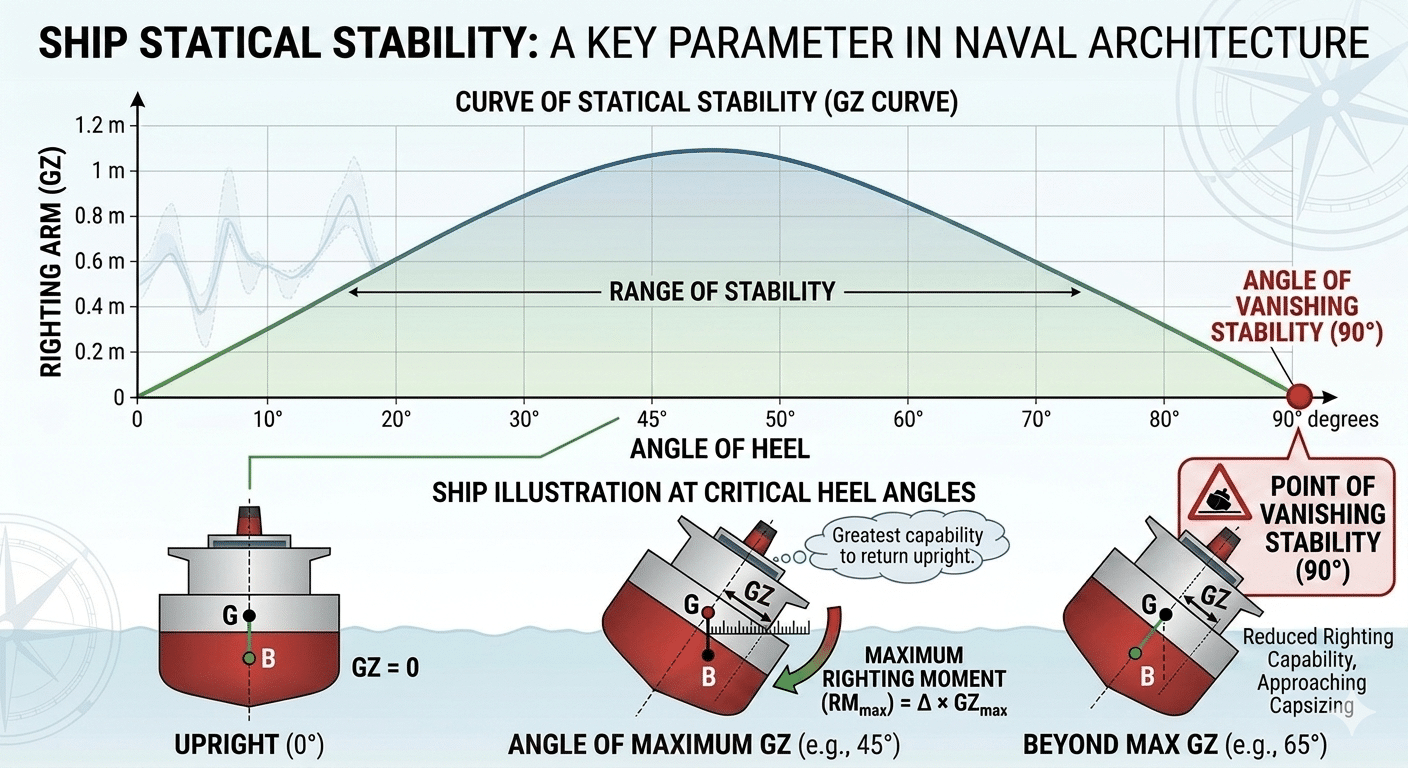
Every steel vessel on the ocean has a hidden breaking point. It is not about the metal hull cracking. It is not about the massive engines failing. Instead, it is a strict boundary made of pure physics. When a fierce storm pushes a ship sideways, the vessel naturally fights back. It desperately wants to stand up straight. But this fighting power does not last forever. There is a precise, mathematical angle where the ship simply gives up. We call this exact angle the point of vanishing stability. Once a ship crosses this invisible line, it cannot save itself. It will flip completely upside down. Let us explore how this boundary works, why it is so dangerous, and how we keep ships safely away from the edge.
The Absolute Limit of a Ship’s Balance
A floating ship is always playing a giant game of tug-of-war. Gravity constantly pulls the ship downward. At the exact same time, the ocean water pushes the ship upward. When a wave tilts the ship, these two forces shift their positions. They create an invisible lever inside the hull. In the maritime world, we call this the righting lever. This lever physically twists the ship back to a flat, safe position.
At first, as the ship leans more, this twisting force gets stronger. Think of it like stretching a thick rubber band. The further you pull the rubber band, the harder it tries to snap back. The ship fights back harder against the wind. But eventually, the ship leans too far. The straight sides of the hull plunge completely underwater. The flat walking deck dips below the sea surface. When this happens, the ship loses a massive amount of its upward push from the water.
Because the water stops pushing up effectively, the invisible lever starts to shrink. The ship’s twisting power fades away rapidly. If the storm keeps pushing, the lever shrinks all the way down to zero. That exact moment is the point of vanishing stability. The rubber band has stretched too far and snapped. The ship has zero energy left to pull itself up. It is completely exhausted and completely defenseless.
What Happens When the Ship Goes Too Far?
Hitting this exact limit is a sailor’s absolute worst nightmare. If a massive wave pushes a ship to land perfectly on this specific angle, the vessel freezes for a split second. It enters a rare state of neutral balance. It does not pull itself up, but it does not actively flip over, either. It is perfectly balanced on a highly dangerous edge.
However, the open ocean never stops moving. The absolute smallest gust of wind will push the ship past that frozen point. The moment the ship leans even one inch past the point of vanishing stability, the physics of the ocean reverse completely.
The invisible lever becomes a negative force. Gravity and the ocean water stop working together to save the ship. Instead, they join forces to actively drag the ship downward. Gravity takes total control and pulls the heavy top of the ship toward the sea floor. The vessel will violently and rapidly flip upside down. This is called a capsize. Because the physical forces are actively pulling the ship underwater, the crew is powerless to stop the roll. Once this boundary is crossed, the ship cannot recover on its own.
How We Build Ships to Avoid This Danger
Because crossing this line is always fatal, we work extremely hard to push this boundary as far away as possible. The physical shape of the ship is our very best defense. Ships built with very tall, watertight steel sides are the safest in the world. We call these tall sides the ship’s “freeboard.” When a ship has a high freeboard, the ocean water cannot easily spill onto the main deck. The ship keeps its fighting power even at extreme, severe angles.
How the crew loads the cargo also changes this boundary daily. If a crew loads heavy shipping containers high up on the main deck, the ship becomes very top-heavy. A top-heavy ship reaches its breaking point much faster. It might hit its limit and flip at only 50 degrees of tilt. Loading heavy weight at the very bottom of the hull pushes the breaking point further away, perhaps to 80 or 90 degrees.
To prevent mistakes, global rules from the International Maritime Organization (IMO) require strict safety computers on every single commercial ship. These computers instantly warn the crew if the ship is too top-heavy before they ever leave the dock. National groups like the United States Coast Guard (USCG) also inspect these vessels closely. They make sure every ship has a wide, safe net before facing the unpredictable forces of the open ocean.
Pertinent Q&A
1. Where do we find this exact angle on a ship’s safety charts? Captains use a special graph called a stability curve. This graph draws a picture of the ship’s twisting power. The line on the graph goes up as the ship gets stronger, then falls down as the ship gets weaker. The exact place where the line hits the absolute bottom (the zero mark) is the point of vanishing stability.
2. Do all ships have the same breaking point? No, every ship is entirely different. A wide, flat river barge is very stable at first, but its deck goes underwater quickly. A river barge might hit its limit at only 40 degrees. An ocean rescue boat is designed very differently. It has a sealed roof and a heavy bottom. It might not hit its limit until 120 degrees, making it almost impossible to flip over.
3. Can a ship ever recover if it passes this point? In reality, no. Once a ship passes this specific angle, the natural laws of physics work against the vessel. Gravity actively pulls it upside down. The only way it could survive is if another massive wave instantly hit the opposite side of the ship, pushing it back over the safety line. That is a near-impossible miracle.
4. How does the crew use ballast water to fix this? Ships have massive, empty tanks built into the very bottom of the hull. These are called ballast tanks. If the safety computer shows the ship will hit its breaking point too early, the crew pumps heavy ocean water into these bottom tanks. This adds massive weight to the floor of the ship. It lowers the Center of Gravity and pushes the breaking point to a much safer, larger angle.
