
When the Ocean Pours In: What is the Angle of Flooding?
Every steel ship has holes in it. Massive diesel engines need massive amounts of air to breathe. The crew needs exhaust pipes and fresh air vents to survive. These necessary openings are the ultimate weak points of any floating vessel. If a fierce storm pushes a ship too far onto its side, these open pipes will eventually plunge underwater.
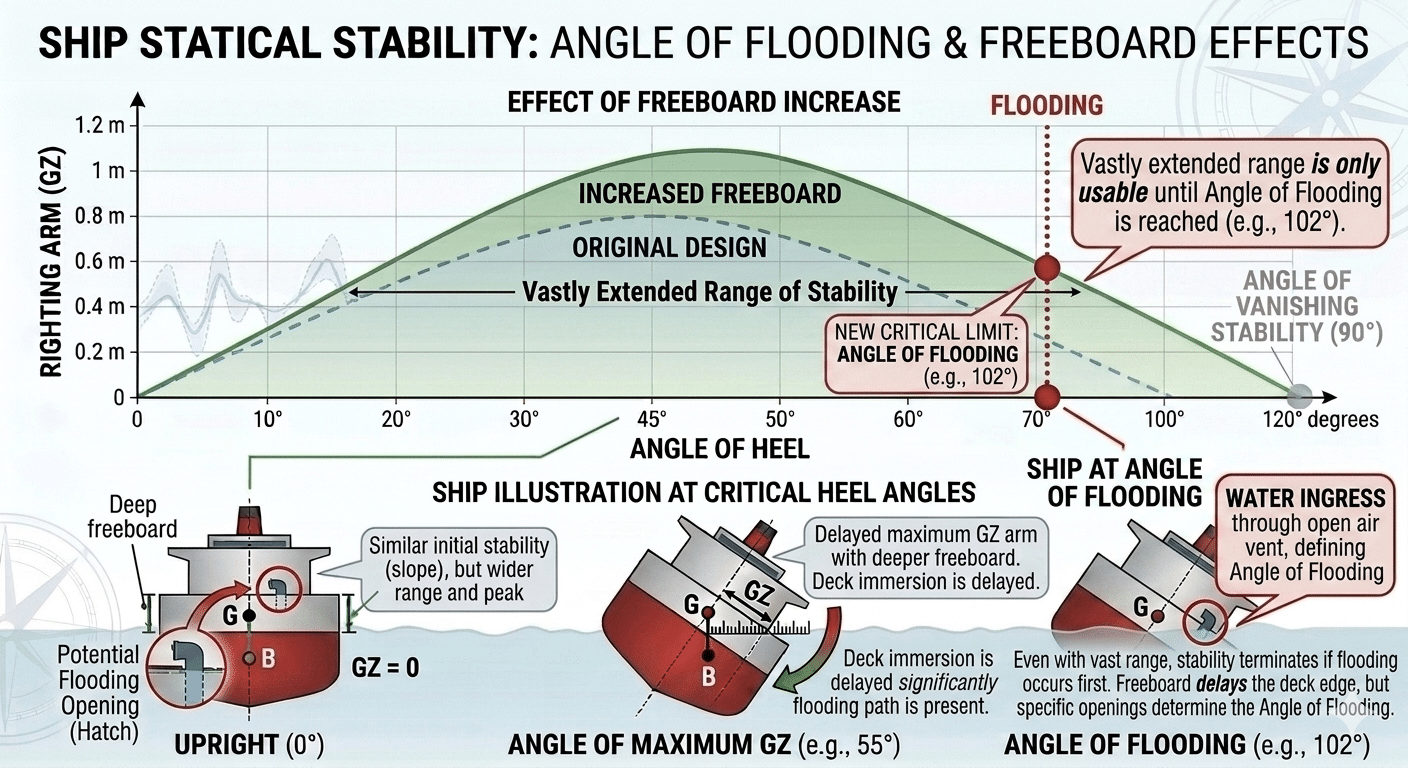
The exact degree of tilt where ocean water begins pouring freely into the ship’s internal spaces is called the angle of flooding. In the maritime industry, it is also known as the downflooding angle. This specific number is a hard, physical boundary between floating safely and actively sinking. Let us look at why these open doors are so dangerous, how they instantly erase a ship’s stability, and how engineers build vessels to avoid this fatal tipping point.
The Open Doors to the Sea
A commercial cargo ship is not a fully sealed submarine. It must interact with the outside air. Because of this, the main deck is covered with various air pipes, engine room vents, and cargo hatch covers. Many of these openings cannot be perfectly sealed shut while the ship is operating.
When a violent wave hits the ship, the vessel leans over. First, the side of the hull pushes into the water. Next, the edge of the flat main deck dips below the ocean surface. If the ship continues to tilt, the water will creep further and further across the deck. Eventually, the water level will reach one of those unsealed vents.
The angle of flooding is officially reached the very millisecond that the lowest, unsealed opening slips underwater. Once this boundary is crossed, the ocean pours directly into the belly of the ship. This is not a slow leak. Thousands of tons of heavy seawater can rush into the engine room or cargo holds in a matter of minutes.
Erasing the Safety Graph
To understand how dangerous this is, we have to look at the ship’s safety graph. This graph is called the Curve of Statical Stability. It shows the ship’s invisible twisting power. Normally, a ship will keep fighting back against a tilt until it reaches its absolute mathematical limit (the point of vanishing stability).
However, the angle of flooding violently interrupts this math. Let us pretend a ship’s graph shows it can theoretically lean to 70 degrees before it flips over. But, let us also say an open engine vent dips underwater at 40 degrees. In the eyes of maritime law and physics, that ship’s safety zone instantly stops at exactly 40 degrees.
The extra 30 degrees of theoretical safety completely disappear. It simply does not matter if the ship still has the twisting power to stand up. If the engine room is rapidly filling with thousands of tons of heavy ocean water, the ship loses its buoyancy. The incoming water acts like a massive, shifting anchor that will quickly drag the vessel straight down to the sea floor. The safety curve officially dies the moment downflooding begins.
Designing to Keep the Water Out
Because downflooding is a fatal event, shipbuilders work tirelessly to push this angle as high as possible. Their goal is to make sure the ship will capsize from pure physics long before water ever enters an open vent.
To achieve this, engineers use smart placement. First, they build vent pipes very tall. A tall pipe must lean much further over before its opening touches the sea. Second, they place all critical openings as close to the center line of the ship as possible. If a vent is located on the extreme outer edge of the deck, it will hit the water very early. If it is located exactly in the middle of the ship, the vessel has to tilt to a massive, extreme angle before the water can reach it.
Global safety groups, such as the International Maritime Organization (IMO), write strict laws regarding these openings. They demand that any opening that might dip underwater early must be fitted with heavy, watertight steel covers. National groups like the United States Coast Guard (USCG) strictly inspect these vents and covers to ensure every ship is fully armored against the invading ocean.
Pertinent Q&A
1. What is the difference between Deck Edge Immersion and the Angle of Flooding? Deck edge immersion is the exact angle where the flat side of the main deck touches the water. The angle of flooding usually happens after deck edge immersion. The deck goes under first, and the water then travels across the deck until it finally finds an open vent or pipe.
2. What happens to the ship’s stability when the water actually gets inside? It causes a terrifying problem called the “Free Surface Effect.” As massive amounts of water slosh back and forth inside the hull, it acts like a heavy, moving wrecking ball. It completely destroys the ship’s Center of Gravity and rapidly strips away any remaining stability the ship had left.
3. Does the loading of the ship change the angle of flooding? Yes, dramatically. If a ship is heavily loaded with cargo, it sinks deep into the water. Because the ship is sitting lower, the vents and pipes are physically closer to the ocean surface. Therefore, a fully loaded ship will reach its flooding angle much faster than an empty ship.
4. Can a ship ever survive crossing the downflooding angle? It is extremely rare, but possible if the ship is built with specialized watertight compartments. If the water pours into a small, heavily sealed room that is completely blocked off from the rest of the ship, the vessel might stay afloat. However, if water pours into a massive space like the main engine room, the ship will be lost.
