
The Elevator Rule: Understanding the Effect of Vertical Shift of Weights on GM
Moving a heavy box from the bottom of a ship to the top deck does not change the total weight of the vessel. Since the weight stays the same, the ship does not sink any deeper into the ocean. However, this simple action completely changes how the ship balances against the waves.
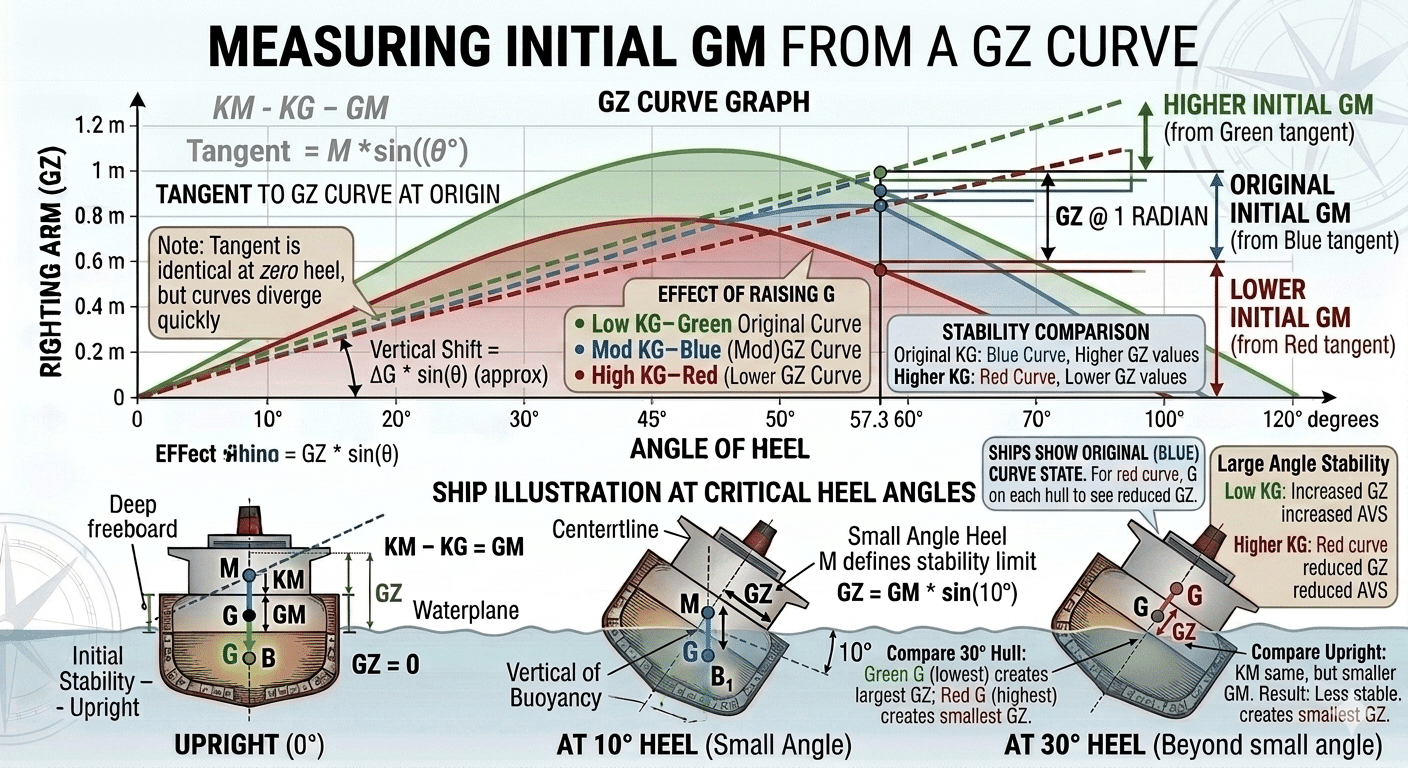
In naval architecture, we measure a ship’s initial safety using a distance called the Metacentric Height, or “GM”. This is the physical gap between the ship’s Center of Gravity (G) and its pivot point (M). When the crew moves heavy cargo straight up or down, they are playing directly with this safety gap. Understanding the effect of vertical shift of weights on GM is the ultimate key to safe cargo loading. Let us explore how this invisible gap stretches and shrinks, and why moving weight upward is the fastest way to put a ship in danger.
The Core Rule: Gravity Follows the Weight
To understand how GM changes, we must first look at the Center of Gravity (point G). Point G is the exact mathematical center of all the weight on the ship. The golden rule of physics is simple: the Center of Gravity always moves in the exact same direction that the weight moves.
If you take a heavy shipping container and use a crane to lift it from the lower hold up to the main deck, point G physically moves upward into the air. If you take that same container and lower it deep into the belly of the ship, point G moves straight downward.
But what happens to the pivot point (point M)? Because the total weight of the ship did not change, the underwater shape of the hull stays exactly the same. Because the underwater shape does not change, point M stays completely frozen in place. Therefore, a vertical shift only moves point G. Because G moves while M stands still, the physical distance between them (the GM) must either shrink or grow.
Moving Weight Upward: Shrinking the Safety Gap
Moving weight high into the air is a massive hazard. When a crew moves heavy cargo to an upper deck, point G moves straight upward. Because point M is frozen high up in the ship, moving G upward pushes it dangerously close to M.
Because the two points are closer together, the Metacentric Height (GM) shrinks. This is a very dangerous situation. A smaller GM means the ship has a tiny righting lever. The ship loses its initial fighting power. It becomes “tender,” meaning it will roll lazily and deeply when pushed by a wave. If the crew moves too much weight upward, point G might even rise above point M. This creates a negative GM, causing the ship to immediately flop onto its side. To prevent catastrophic capsizing, global authorities like the International Maritime Organization (IMO) demand strict cargo plans that calculate this exact loss of GM before the ship leaves the port.
Moving Weight Downward: Building a Stiff Ship
To make a ship safer, the crew must do the exact opposite. If heavy cargo is moved from the top deck down into the lowest cargo hold, point G moves straight downward.
This downward shift pulls point G much further away from the frozen point M. The physical gap between the two points stretches out. Therefore, the Metacentric Height (GM) grows larger. A large GM means the ship has massive initial twisting power. The ship becomes “stiff” and highly stable. It will forcefully snap back to a flat, upright position when ocean waves push against it. Respected groups like the Society of Naval Architects and Marine Engineers (SNAME) specifically design deep lower holds to allow crews to easily lower the ship’s Center of Gravity. National agencies, including the United States Coast Guard (USCG), actively inspect ships to ensure the final GM is large enough to survive rough ocean crossings safely.
Pertinent Q&A
1. Does a vertical shift of weight change the ship’s draft? No, it does not. A “shift” means the cargo was already on the ship; it was just moved to a different deck. Because no new weight was added to the vessel, the ship displaces the exact same amount of water. The draft stays exactly the same.
2. How do deck officers calculate the exact distance point G moves? Officers use a very simple and reliable physics formula to find the exact vertical shift of the Center of Gravity ():
In this formula, is the weight of the cargo being moved, is the vertical distance the cargo was moved, and is the total massive weight (displacement) of the entire ship.
3. What happens to the ship’s rolling speed if GM gets larger? When weight is moved downward and GM grows, the ship becomes very “stiff.” A stiff ship fights back against the waves very aggressively. This causes the ship to roll back and forth very quickly. While a large GM is safe, a lightning-fast rolling speed can be physically uncomfortable for the crew and can damage cargo.
4. How can the crew easily lower point G if they cannot move the cargo? If the cargo is already locked in place, the crew can use the ship’s ballast system. They pump thousands of tons of heavy ocean water into empty tanks located at the absolute bottom of the hull. While this technically adds weight rather than shifting it, it achieves the same goal: it forcefully drags the ship’s total Center of Gravity (point G) downward, increasing the GM and making the ship safer.
