
Heavy Hits: How the Density of the Liquid in the Tank Affects FSE
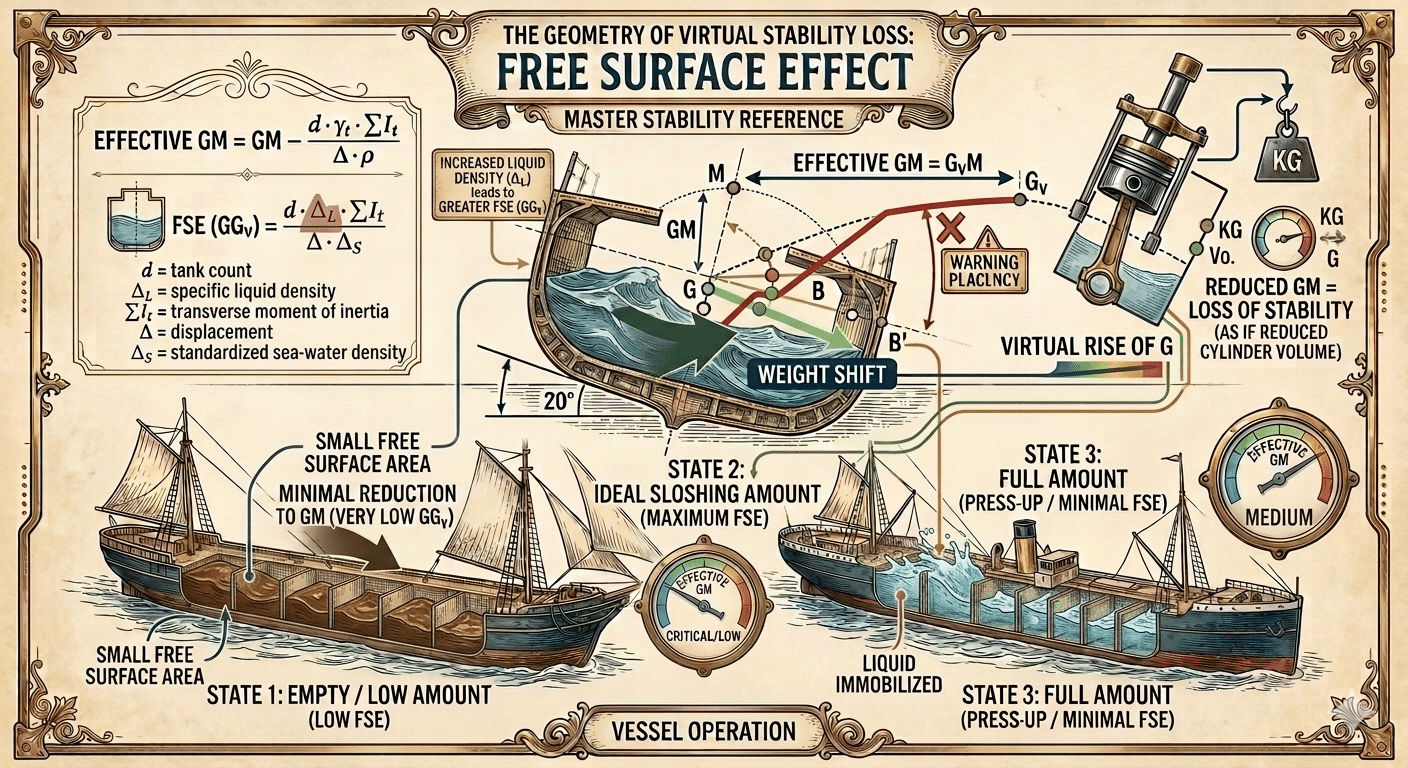
We already know that the physical depth of the liquid in a rectangular tank does not change the Free Surface Effect (FSE). The geometry of the water’s surface stays exactly the same whether the tank is 10% full or 90% full. However, the type of liquid inside that tank is a completely different story.
If you swap out light freshwater for heavy, thick drilling mud, the danger level skyrockets. So, how exactly does the density of the liquid in the tank affect FSE? It acts as a massive multiplier for the ship’s stability penalty. A denser liquid hits the sides of the tank with much more brutal physical force, violently dragging the ship’s balance point off-center. Let us explore the physics behind this heavy slosh and why captains fear dense liquid cargoes.
The Weight of the Slosh
To understand why density matters, you have to remember what the Free Surface Effect actually is. It is the physical shifting of weight from the high side of the ship to the low side of the ship during a roll.
Gravity always pulls the liquid to the lowest possible point. When the liquid rushes to the low side of the tank, it drags the ship’s Center of Gravity (G) horizontally along with it. This sideways shift is what ultimately causes the dangerous virtual upward shift in the ship’s balance.
If the tank is filled with a low-density liquid (like aviation fuel), the weight sliding across the tank is relatively light. The Center of Gravity only gets pulled a tiny bit. But if the tank is filled with a high-density liquid (like heavy fuel oil), the weight sliding across the tank is massive. This incredibly heavy mass pulls the ship’s Center of Gravity violently outward, dragging the ship deeper into the tilt and making it much harder for the vessel to stand back up.
The Mathematics of Density
Deck officers use a specific formula to calculate exactly how much safety is being stolen by the sloshing liquid. This stolen safety is called the Free Surface Correction (FSC). Looking at the formula reveals exactly how density multiplies the danger.
The total penalty is calculated by comparing the weight of the shifting liquid to the weight of the entire ship. The formula looks like this:
-
is the surface area geometry of the tank (which is driven entirely by the tank’s width).
-
is the density of the liquid inside the tank.
-
is the total heavy weight (displacement) of the entire ship.
Because the density () is directly multiplied into the top of the equation, the relationship is perfectly linear. If you put a liquid in the tank that is twice as dense, the Free Surface Effect penalty becomes exactly twice as large. The density of the liquid in the tank affects FSE by acting as a direct volume knob for the danger.
Real-World Maritime Dangers
This math has serious consequences out on the open ocean. A ship carrying light, refined liquids has a much larger margin for error than a ship carrying heavy, unrefined liquids.
For example, fresh drinking water has a density of . Heavy Fuel Oil (HFO), which powers the ship’s massive engines, has a density of around . These are fairly standard.
However, specialized offshore supply vessels often carry liquid drilling mud, which can have a massive density of or more. If a supply vessel has a wide, slack tank full of heavy drilling mud, the FSE penalty will be two and a half times worse than if that same tank held fresh water. Captains carrying dense liquid cargoes must be obsessively careful to keep their tanks either completely 100% pressed full or completely empty to avoid this massive stability penalty.
Pertinent Q&A
1. Does seawater create a worse FSE penalty than freshwater? Yes, slightly. Seawater has salt and minerals dissolved into it, giving it an average density of . Because it is slightly denser than freshwater (), a slack tank of seawater will generate a slightly larger penalty than a slack tank of freshwater.
2. Does the temperature of the liquid change the FSE? Yes, it actually does! As liquids heat up, they expand and become less dense. As they cool down, they contract and become denser. A tank of freezing cold liquid will technically create a slightly higher FSE penalty than a tank of boiling hot liquid, simply because the cold liquid is denser.
3. Does a heavier ship cancel out the heavy liquid? Yes, it can. Look at the bottom of the math formula: the total weight of the ship (). If the entire ship is incredibly heavy, it is harder for the sloshing liquid to bully the ship around. A massive, fully loaded cargo ship will suffer a smaller FSE penalty from a slack tank than a small, empty ship will suffer from that exact same tank.
4. What happens if two different liquids are mixed in the same tank? If oil and water are in the same tank, they will separate, with the lighter oil floating on top of the heavier water. The FSE is usually calculated using the density of the heaviest liquid in the tank (the water) to ensure the captain is mathematically prepared for the worst-case scenario.
