
The Depth Illusion: Why FSE Completely Ignores Tank Height?
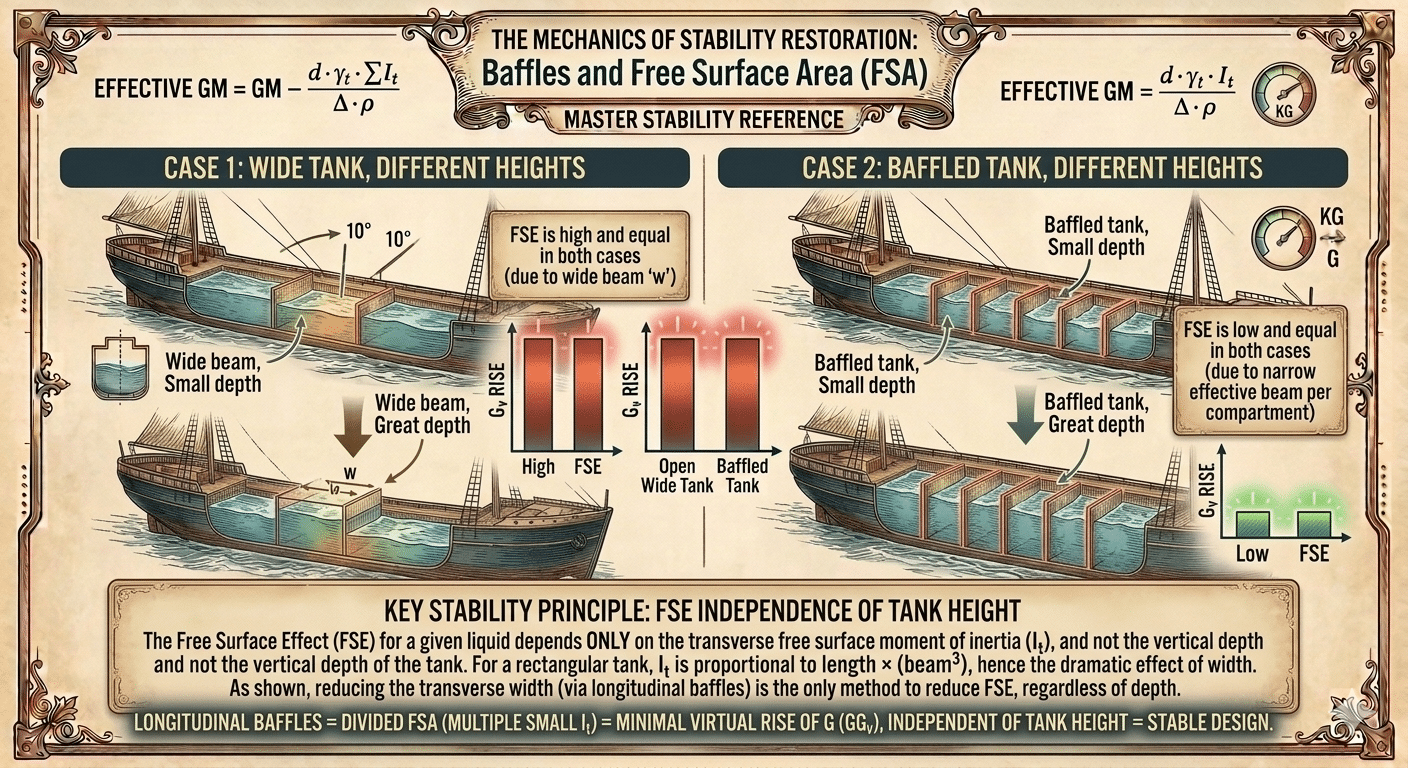
It sounds crazy: how can a massive, deep tank of sloshing water be just as dangerous as a shallow puddle? Human intuition tells us the deep tank should be worse. However, maritime physics completely ignores human intuition. If a tank has straight, vertical walls, the FSE is completely independent of the height of the tank. A tank that is 10% full destroys the exact same amount of ship stability as a tank that is 90% full.
Let us break down exactly why the math ignores the depth of the water.
1. The Secret of the “Shifting Wedge”
To understand this rule, you have to stop looking at the entire tank and focus only on the very top layer of the liquid.
-
Water wants to be flat: When the ocean pushes a ship into a tilt (a roll), gravity forces the surface of the water inside the tank to stay perfectly level with the horizon.
-
Only the top moves: To stay level, a triangular slice of water moves from the high side of the tank over to the low side. In naval architecture, this moving triangle is called the “shifting wedge.”
-
The bottom is frozen: The thousands of tons of water sitting deep down below this moving wedge do not slide side-to-side. They simply act like a solid floor.
-
The Result: Because the Free Surface Effect (FSE) is caused only by weight sliding horizontally, only that top shifting wedge matters. A shallow tank and a deep tank will both create the exact same shifting wedge, meaning the danger is identical.
2. The Mathematical Proof
Deck officers do not rely on visual illusions; they rely on hard mathematics. The penalty stolen from the ship’s safety margin is calculated using a formula for the liquid’s surface area.
For a rectangular tank, the formula to find the geometry of the slosh is:
-
is the Length of the tank (front to back).
-
is the Breadth (width) of the tank.
Look closely at this universally accepted formula. There is absolutely no variable for Height () or Depth (). The math proves that the FSE penalty is generated entirely by the two-dimensional footprint of the liquid’s surface.
3. The One Exception: Curved Hulls
There is only one scenario where the depth of the liquid changes the FSE penalty. This happens if the tank does not have perfectly straight, vertical walls.
-
Angled Walls: Many tanks built into the bottom of a ship (like double-bottom tanks) follow the curved or V-shaped angle of the outer steel hull.
-
Wider is Worse: Because the walls are angled outward, the tank physically gets wider as you go higher up.
-
The Danger: In this specific case, deeper water means a wider surface. Because width () is cubed in our math formula, that newly widened surface area causes the FSE penalty to explode.
Pertinent Q&A
1. Does the physical placement of the tank (high vs. low) change the FSE? The FSE penalty itself does not change. A tank on the roof creates the exact same sloshing penalty as an identical tank in the basement. However, placing a heavy tank on the roof makes the ship top-heavy, meaning the ship has less starting stability to survive the slosh.
2. What happens if the tank is so shallow that the floor is exposed? This is called a “dry bottom” condition. If the water level is so low that it all rushes to one corner and leaves the rest of the floor completely dry, the standard math formula breaks. Because the puddle shrinks and no longer touches both walls, the FSE penalty actually drops significantly.
3. Does the total weight of the ship cancel out the FSE? It heavily dilutes it. The final penalty is calculated by taking the slosh geometry and dividing it by the total weight of the entire ship. A massive, fully loaded cargo ship will barely feel the FSE of a small slack tank, whereas an empty, lightweight ship might capsize from that exact same tank.
4. How do loading computers handle the height of the liquid? Modern ship loading computers use digital sensors in the tanks. If the computer knows the tank has straight vertical walls, it simply applies a flat, constant FSE penalty the moment the tank drops below 98% full, completely ignoring the depth sensor until the tank is empty.
